Which of the Following Best Describes a Limiting Reactant
Which of the following describes a limiting reagent in a chemical reaction. Identification of the limiting reactant makes it possible to calculate the theoretical yield of a reaction.
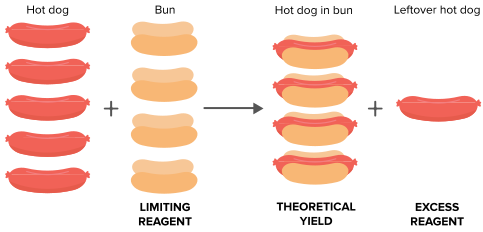
Limiting Reactant And Reaction Yields Article Khan Academy
Get started for free.

. Which of the following best describes a limiting reactant. A limiting reactant is used up before the excess reactant and thus limits the reaction compare the actual yield and the theoretical yield from a reaction the actual yield is the measured quantity of a product actually made in a reaction while the theoretical yield is the maximum calculated quantity of product that could be formed. The reactant that limits the position of equilibrium in a reversible chemical change.
C An inert element. The reason there is a limiting reactant is that elements and compounds react according to the mole ratio between them in a balanced. The limiting reactant is the one that produces the largest amount of product in a.
Which of the following describes a limiting reactant. The limiting reactant is the one that is completely used up. ANumber of individuals per unit area BNumber of species that can reproduce CAnything that limits the size of a population DAnything that permits species invasion.
The limiting reactant is the reactant that is completely consumed in a chemical reaction. A The reactant that is completely used up by a reaction. B The reactant that can produce the greatest amount of product The reactant that remains at the end of the reaction.
Which of the following statements best describes a limiting reactant. The reactant that is used up the most. Asked Jan 11 2019 in Chemistry by Parreira.
Which of the following BEST describes the limiting reagent. 5 points The reactant that is used up the least. B The reactant that runs out last and limits how much product can be made.
The reactant that is leftover after the reaction. The limiting reactant is the one that is left over. The reactant that remains at the end of the reaction.
The reactant in excess is any reactant that occurs in a quantity greater than that is required to completely react with the limiting reactant. 505 answer choices. Find and create gamified quizzes lessons presentations and flashcards for students employees and everyone else.
A The reactant that is present at the smallest mass. The amount of product can be calculated based on the amount of limiting reactant. The reactant that is used up the least.
D The reactant that runs out first and limits how much product can be made. Answer 1 of 3. The reactant that is used up before the others.
The reactant that limits the rate or speed of a chemical reaction. The limiting reactant is always the one that has the smallest starting amount. Firstly by looking at the balanced equation for the reaction and secondly by knowing the mass of each reactant involved in the reaction along with their molar masses.
Which of the following best describes a limiting reactant a. Which of the following best describes limiting factors. D Ammonia is the limiting reactant.
2 6SiO2 10C 6CaSiO3 P4 10CO 310 gmol 601 gmol 120 gmol The molar mass for each reactant is shown below the reactant and the mass of each reactant for this problem is given above. The reactant that is used up the least The reactant that is used up the most The reactant that is used up before the others The reactant that is leftover after the reaction. Because aluminum acts as a limiting reactant.
The reactant that is used up the most. The reactant the limits the position of equilibrium in a reversible chemical change. Consider the following reaction-.
A Molecular oxygen is the limiting reactant. B Molecular nitrogen is the limiting reactant. It determines the maximum amount of product that can be formed It determines the minimum amount of product that can be formed It is the reactant with the smallest amount of mass in grams.
Which of the following statements best describes a limiting reactant. How will you identify limiting reactant in a chemical reaction. Chemistry questions and answers.
C Molecular nitrogen is the excess reactant. Which one of the following statements best describes the limiting reactant. A The reactant that runs out last and limits how much product can be made B The reactant that is present at the smallest mass C The reactant that runs out first and limits how much product can be made D An inert element.
The limiting reactant or limiting reagent is a reactant in a chemical reaction that determines the amount of product that is formed. If you react 3406 g NH3 with 6400 g O2 which of the following statements best describes the limiting reactant situation of this reaction. WILL MARK BRAINLIEST Which of the following statements best describes a limiting reactant.

Limiting Reactants Lessons Blendspace
Limiting Reactant Easy Science Study Skills Ap Chemistry Chemistry
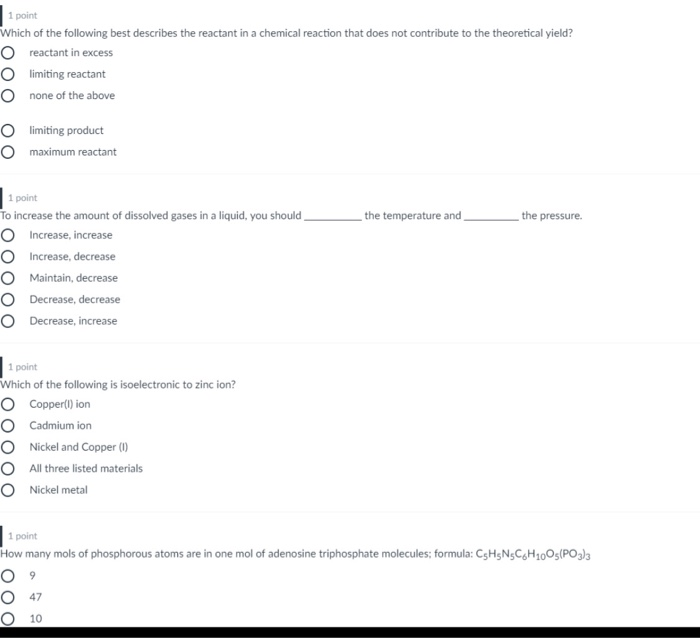
Solved 1 Point Which Of The Following Best Describes The Chegg Com


Comments
Post a Comment